


Naval VSAT Market Outlook: Navigating the Future of Maritime Defense Connectivity
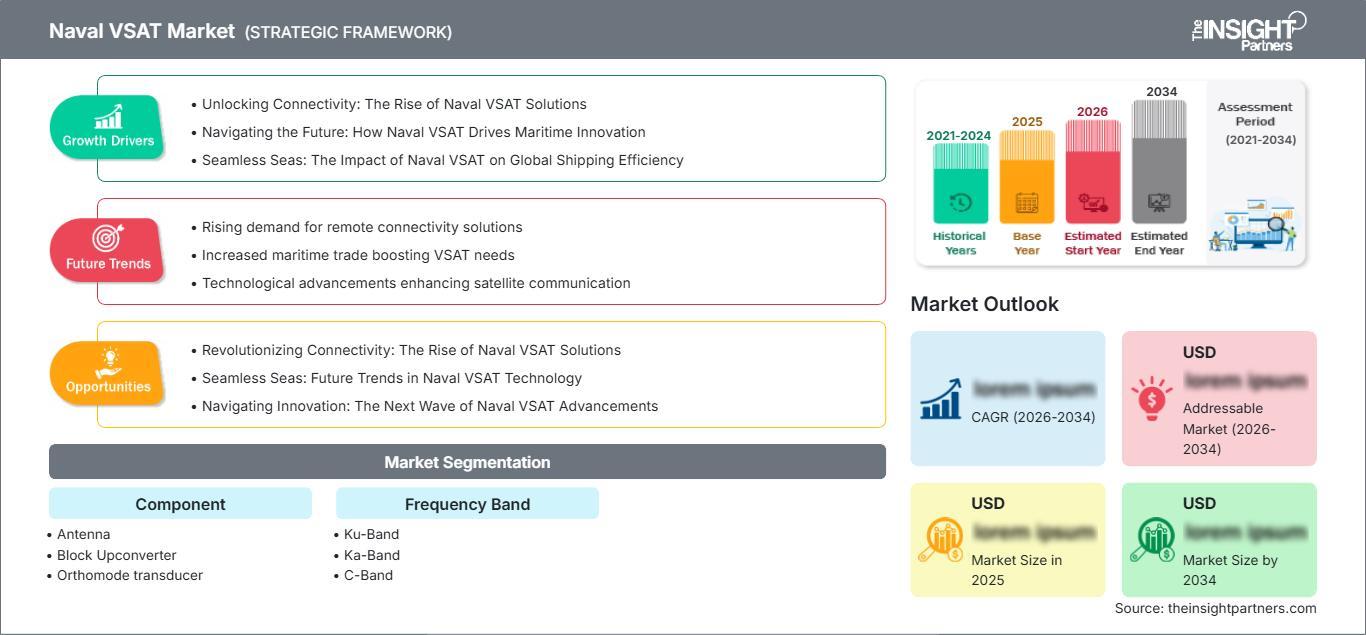
The Naval VSAT Market Outlook is defined by a rapid transition toward high-capacity, resilient, and multi-orbit satellite communication systems. As naval operations become increasingly data-centric, the reliance on Very Small Aperture Terminal (VSAT) technology has shifted from a luxury to a fundamental operational requirement. By 2034, the integration of next-generation satellite constellations and software-defined hardware is expected to redefine how maritime forces maintain command and control across the high seas.
Industry data suggests that the broader maritime satellite communication sector is on a trajectory to reach USD 11.8 billion by 2034, with the naval segment acting as a high-value growth engine. This expansion is underpinned by a compound annual growth rate (CAGR) of approximately 11.42%, reflecting significant investments in ruggedized equipment and secure connectivity services. The shift toward higher frequency bands, such as Ka-band and X-band, is providing the necessary throughput to support everything from real-time biometric data for crew monitoring to high-definition video feeds for surveillance.
Download Sample Report –
https://www.theinsightpartners.com/Sample/TIPRE00016936
Key Market Report Drivers
Evolution of Multi-Orbit Satellite Architectures A primary factor in the is the emergence of Low Earth Orbit (LEO) and Medium Earth Orbit (MEO) satellite constellations. Unlike traditional geostationary (GEO) systems, these non-geostationary orbit (NGSO) solutions offer significantly lower latency and higher speeds. Naval vessels are increasingly adopting hybrid terminals that can seamlessly switch between orbits, ensuring that communication remains uninterrupted even if a specific satellite link is contested or obstructed.
Demands of Data-Intensive Naval Platforms The modernization of naval fleets has led to the deployment of sophisticated platforms equipped with a multitude of sensors, Radars, and Electronic Warfare (EW) suites. These systems generate massive volumes of data that must be transmitted to shore-based command centers for real-time analysis. The need for high-throughput satellite (HTS) capabilities to manage this "big data" at sea is a major driver for the procurement of advanced VSAT terminals.
Focus on Cybersecurity and Electronic Resilience As naval vessels become more connected, they also become more exposed to digital threats. Modern market reports highlight the rising demand for VSAT systems that incorporate advanced encryption, anti-jamming capabilities, and "Low Profile" antenna designs to reduce the ship's radar cross-section. The drive to protect mission-critical data from sophisticated cyber-adversaries is pushing naval forces to upgrade legacy hardware with secure, military-grade VSAT solutions.
Expansion of Unmanned and Autonomous Systems The rise of Unmanned Surface Vehicles (USVs) and Unmanned Underwater Vehicles (UUVs) is creating a new frontier for the naval VSAT industry. These autonomous platforms require constant, high-reliability links for remote piloting and data offloading. As navies integrate more robotic "wingmen" into their fleets, the demand for compact, high-performance VSAT antennas that can be mounted on smaller, unmanned platforms is surging.
Top Players and Market Innovators
The competitive landscape is dominated by firms that can bridge the gap between commercial innovation and military-grade durability.
- Viasat Inc. (including Inmarsat): A powerhouse in global satellite connectivity, providing high-speed Ka-band services and the NexusWave hybrid network.
- Thales Group: Specializes in end-to-end secure communication systems and high-end naval satellite payloads.
- Cobham Satcom: Recognized for its high-performance Sea Tel and SAILOR antenna systems used by major naval forces.
- Orbit Communication Systems Ltd.: A leader in tracking antenna systems that offer high stability and multi-band capabilities for naval ships.
- KVH Industries, Inc.: Known for its TracPhone systems and integrated "Connectivity as a Service" models for maritime users.
- L3Harris Technologies: Provides sophisticated SATCOM terminals designed for the most demanding military environments.
- SpaceX (Starlink): A disruptive entrant whose LEO constellation is increasingly being tested and adopted for naval auxiliary and support roles.
Strategic Regional Outlook
While North America continues to lead in terms of total spending and technological maturity, the Asia-Pacific region is emerging as the fastest-growing market. Regional tensions and the rapid expansion of blue-water navies in countries like India and Japan are driving large-scale procurement programs for integrated SATCOM suites. In Europe, the focus remains on interoperability within NATO frameworks, ensuring that diverse naval fleets can share a common operating picture through standardized VSAT protocols.
The through 2034 remains overwhelmingly positive. As satellite technology continues to advance, the ability of naval commanders to leverage real-time information will be the ultimate differentiator on the modern battlefield. The move toward software-defined terminals and more accessible NGSO bandwidth ensures that VSAT will remain the lifeblood of maritime defense for the foreseeable future.
Contact Information -
Email: sales@theinsightpartners.com
Phone: +1-646-491-9876
Also Available in :
 Dutch
Dutch
 English
 Arabic
 French
 Spanish
 Portuguese
 Deutsch
 Turkish
 Italiano
 Russian
 Romaian
 Portuguese (Brazil)
 Greek
Greek