


Fatigue Testing Machine Market Analysis and Overview: Navigating the Future of Material Durability (2025-2031)
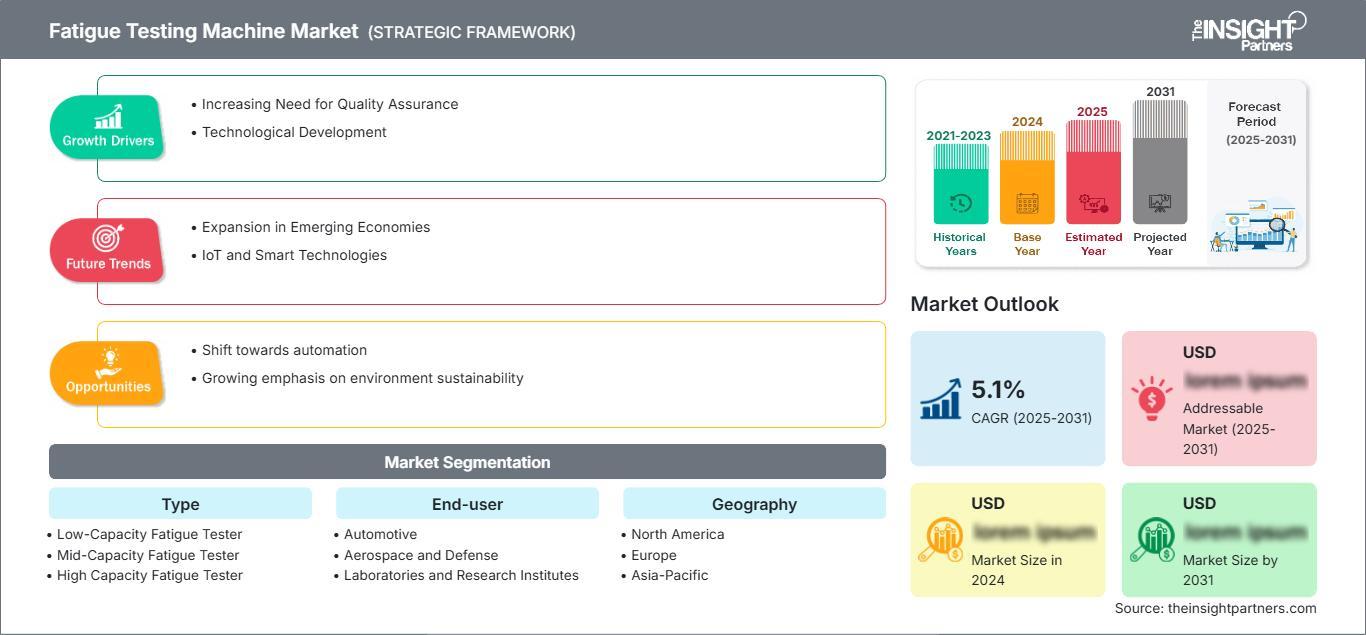
Strategic engineering decisions today rely heavily on the accuracy of material validation. The Fatigue Testing Machine Market Analysis and Overview reveals a sector that is rapidly evolving from basic mechanical stress testing to high-fidelity, digitally integrated structural analysis. These machines are the gatekeepers of safety, ensuring that every alloy, composite, and polymer used in critical infrastructure can withstand the rigors of repeated stress cycles without premature failure.
As manufacturers face increasing pressure to innovate with lighter and stronger materials, the role of fatigue testing has expanded. It is no longer just about meeting minimum safety standards; it is about defining the absolute limits of performance to gain a competitive edge in product longevity and reliability.
Download Sample Report –
https://www.theinsightpartners.com/sample/TIPRE00010611
Catalysts Expanding the Fatigue Testing Machine Market Size
The expansion of the is intricately linked to the automotive industry’s aggressive pursuit of lightweighting. To meet carbon emission targets, automakers are swapping traditional steel for advanced composites and high-strength alloys. Because these materials possess complex fatigue behaviors, manufacturers must invest in specialized testing rigs to ensure that lightweight components do not fail under the cyclic vibrations of daily driving. This is particularly true for the Electric Vehicle (EV) sector, where battery trays and motor mounts face unique dynamic stresses.
Safety regulations and liability concerns also play a major role in driving market value. Regulatory bodies in the aerospace and medical sectors have implemented increasingly stringent compliance mandates, requiring documented evidence of fatigue life for every critical component. These mandates force companies to transition from basic testing to high-precision, automated systems, which significantly boosts the Fatigue Testing premium equipment sales and recurring calibration services.
Furthermore, the rise of additive manufacturing (3D printing) has opened a new frontier for testing. 3D-printed parts often exhibit anisotropic properties, meaning they react differently to stress depending on the direction of the load. As 3D printing moves from prototyping to mass production in aerospace and defense, the demand for fatigue testing machines capable of handling these complex geometries has surged, contributing to the overall market growth.
Top Players Defining Market Standards
The competitive landscape of the market is led by engineering giants that provide the hardware and software necessary for complex material validation. These players are instrumental in determining the through their global reach and R&D investments.
Top players in the global fatigue testing machine market include:
- MTS Systems Corporation
- Instron (An ITW Company)
- ZwickRoell GmbH & Co. KG
- Shimadzu Corporation
- ADMET, Inc.
- Tinius Olsen Testing Machine Company
- Controls S.p.A.
- Servotest Testing Mode Ltd
- Fine Manufacturing Industries
- EHF Systems
Capacity and Application Segmentation
When breaking down the , analysts often look at the force capacity and application segments. High-capacity machines (above 500 kN) are the primary revenue drivers in the construction and infrastructure sectors, used for testing bridge cables and steel girders. Conversely, low-to-mid capacity machines (under 100 kN) are seeing explosive growth in the biomedical field, where they are used to test the longevity of hip replacements, dental implants, and heart valves.
The shift toward servo-electric and electro-dynamic machines is another noteworthy trend. While hydraulic systems still dominate the high-load market, electric systems are capturing a larger share of the in laboratory settings. These machines are favored for their lower operational costs, reduced noise levels, and smaller environmental footprint, making them highly attractive to academic research centers and boutique R&D labs.
Future Outlook and Growth Opportunities
By 2031, the is projected to be influenced by the integration of AI and machine learning. Predictive maintenance and automated crack detection will become standard features, allowing for more efficient testing cycles and reduced human error. This technological leap will encourage manufacturers who are currently using legacy systems to upgrade to "smart" testing rigs, ensuring a steady stream of market activity.
As the global manufacturing sector continues to prioritize reliability and sustainability, the fatigue testing machine market will remain a cornerstone of industrial progress. The ability to guarantee the safety and longevity of products is a value proposition that transcends borders, ensuring that the maintains a robust and upward-trending trajectory through the end of the decade.
Contact Information -
Email: sales@theinsightpartners.com
Phone: +1-646-491-9876
Also Available in :
 Greek
Greek
 English
 Arabic
 French
 Spanish
 Portuguese
 Deutsch
 Turkish
 Dutch
Dutch
 Italiano
 Russian
 Romaian
 Portuguese (Brazil)